EMT Practice Test

1. Question Content...


Question List

Question1: Which of the following defines the expected result of a test?

Question2: Which of the following statements is the MOST valid goal for a test team?

Question3: Complete statement and branch coverage means..?

Question4: Which of the following risks represents the highest level of risk to the project?

Question5: Which of the following comparisons of component testing and system testing are TRUE?

Question6: Which pair of definitions is correct?

Question7: Which of the following is the task of a Tester?
i. Interaction with the Test Tool Vendor to identify best ways to leverage test tool on the project.
ii. Prepare and acquire Test Data
iii. Implement Tests on all test levels, execute and log the tests.
iv. Create the Test Specifications

Question8: In a system designed to work out the employee tax to be paid:
_ An employee has $4,000 of salary tax free.
_ The next $1,500 is taxed at 10%.
_ The next $28,000 after that is taxed at 22%.
_ Any further amount is taxed at 40%.
Which of these is a valid Boundary Value Analysis test case?

Question9: Which of the following is a benefit of test independence?

Question10: For which of the following would maintenance testing be used?

Question11: Which of the following statements BEST describes the difference between testing and debugging?

Question12: Which of the following is not a quality characteristic listed in ISO 9126 Standard?

Question13: Which of the following describes structure-based (white-box) test case design techniques?

Question14: What can testing demonstrate?

Question15: Which of the following metrics could be used to monitor progress along with test preparation and execution?

Question16: "How much testing is enough?"

Question17: Which of the following is not a type of incremental testing approach?

Question18: During the software development process, at what point can the test process start?
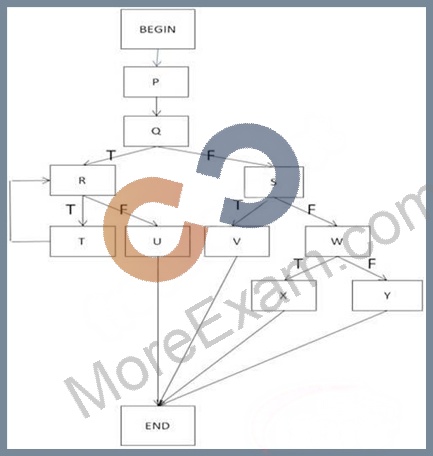
Question19: The flow graph below shows the logic of a program for which 100% statement coverage and 100% decision coverage is required on exit from component testing.
The following test cases have been run:
Test Case 1 covering path P,Q,R,U
Test Case 2 covering path P,Q,S,V
Test Case 3 covering path P,Q,S,W,X
Test case 4 covering path P,Q,S,W,Y
Refer to the exhibit

Question20: A system is designed to accept values of examination marks as follows:
Fail: 0-39 inclusive
Pass: 40-59 inclusive
Merit: 60-79 inclusive
Distinction: 80-100 inclusive
In which of the following sets of values are all values in different equivalence partitions?

Question21: Which of these are objectives for software testing?

Question22: Which of the following statements are correct for walkthroughs?
(i) Often led by the author.
(ii) Documented and defined results.
(iii) All participants have defined roles.
(iv) Used to aid learning.
(v) Main purpose is to find defects.

Question23: Failure is _________

Question24: The purpose of requirement phase is:

Question25: Pick the best definition of quality:

Question26: Which of the following test design techniques is not a black box technique?

Question27: Which of the following are examples of iterative development models?
(i) V-model
(ii) Rapid Application Development model
(iii) Waterfall model
(iv) Agile development model

Question28: What type of test design technique is the most effective in testing screen-dialog flows?

Question29: Which of the following best describes the purpose of non-functional testing?

Question30: Which of the following is MOST important in the selection of a test approach?

Question31: Important consequences of the impossibility of complete testing are:

Question32: How can test execution tools be of most benefit during exploratory testing?

Question33: What do static analysis tools analyze?

Question34: An input field takes the year of birth between 1900 and 2004. The boundary values for testing this field are:

Question35: Code Coverage is used as a measure of what?

Question36: Test Implementation and execution has which of the following major tasks?
i. Developing and prioritizing test cases, creating test data, writing test procedures and optionally preparing the test harnesses and writing automated test scripts.
ii. Creating the test suite from the test cases for efficient test execution.
iii. Verifying that the test environment has been set up correctly.
iv. Determining the exit criteria.

Question37: Consider the following pseudo code
1 . Begin
2 . Read Gender
3 . __Print "Dear"
4 . If Gender = 'female'
5 . Print ("Ms")
6 . Else
7 . __Print ( "Mr")
8 . Endif
9 . End
How many test cases are needed to achieve 100 per cent decision coverage?

Question38: Which of the following is in the correct order (typically)?

Question39: Consider the following pseudo code:
1. Begin
2. Input X, Y
3. If X > Y
4. __Print (X, 'is greater than', Y)
5. Else
6. __Print (Y, is greater than or equal to', X)
7. EndIf
8. End
What is the minimum number of test cases required to guarantee both 100% statement coverage and
100% decision coverage?

Question40: Which of the following could be a disadvantage of independent testing?

Question41: Which of the following pairs of test tools are likely to be most useful during the test analysis and design stage of the fundamental test process?
(i) Test execution tool
(ii) Test data preparation tool
(iii) Test management tool
(iv) Requirements management tool

Question42: What test roles (or parts in the testing process) is a developer most likely to perform?
(i) Executing component integration tests.
(ii) Static analysis.
(iii) Setting up the test environment.
(iv) Deciding how much testing should be automated.

Question43: It is recommended to perform exhaustive tests for covering all combinations of inputs and preconditions.

Question44: Which statement BEST describes when test planning should be performed?

Question45: The four test levels defined for a common V-model testing approach are:

Question46: Which statement below BEST describes non-functional testing?

Question47: Which one of the following roles is typically used in a review?

Question48: What is the purpose of test completion criteria in a test plan:

Question49: Which statement correctly describes the public and profession aspects of the code of ethics?

Question50: Reporting Discrepancies as incidents is a part of which phase:

Question51: Which of the following could be a reason for a failure?
1) Testing fault
2 ) Software fault
3 ) Design fault
4 ) Environment Fault
5 ) Documentation Fault

Question52: Fault Masking is:

Question53: What do you mean by "Having to say NO"..?

Question54: Testers are often seen as the bearer of unwanted news regarding defects. What are effective ways to improve the communication and relationship between testers and others?
a)Communicate factual information in a constructive way.
b)Try to understand how the other person feels and why they react the way they do.
c)Always outsource testing activities.
d)Never record information that could be used to apportion blame to an individual or team.

Question55: What benefits do static analysis tools have over test execution tools?

Question56: Boundary value testing:

Question57: Which of the following is not a part of the Test Implementation and Execution Phase?

Question58: System testing is:
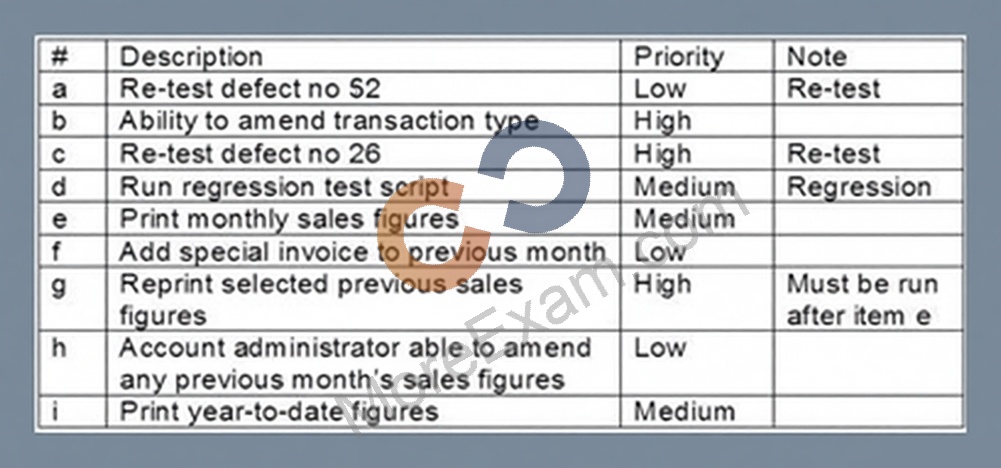
Question59: Refer to the exhibit
The following test cases need to be run, but time is limited, and it is possible that not all will be completed before the end of the test window

The first activity is to run any re-tests, followed by the regression test script. Users have supplied their priority order to tests.
Which of the following gives an appropriate test execution schedule, taking account of the prioritisation and other constraints?

Question60: A deviation from the specified or expected behavior that is visible to end-users is called:

Question61: A new system is about to be developed. Which of the following functions has the highest level of risk?

Question62: The difference between re-testing and regression testing is:

Question63: Which of the following, if observed in reviews and tests, would lead to problems (or conflict) within teams?

Question64: A test management tool is most likely to integrate with which of the following tools?

Question65: Tools like change Man, Clear case are used as..?

Question66: Acceptance test cases are based on what?

Question67: Which of the following is a non-functional requirement?

Question68: A washing machine has three temperature bands for different kinds of fabrics: fragile fabrics are washed at temperatures between 15 and 30 degrees Celsius; normal fabrics are washed at temperatures between 31 and 60 degrees Celsius; heavily soiled and tough fabrics are washed at temperatures between 61 and 100 degrees Celsius.
Which of the following contains only values that are in different equivalence partitions?

Question69: Typically, exit criteria may consist of:

Question70: "Experience based" test design techniques, typically...

Question71: Which of the following is most likely to be a benefit of using static techniques?

Question72: What is the benefit of independent testing?

Question73: Which of the following correctly states a limitation in the use of static analysis tools?

Question74: What is important to do when working with software development models?

Question75: Which is not in sequence in 11 Step Software Testing process..?

Question76: Maintenance testing is:

Question77: Which of the following is a white box testing design characteristic?

Question78: The purpose of exit criteria is:

Question79: Which of the following BEST describes the relationship between test planning and test execution?

Question80: The selection of test cases for regression testing..?

Question81: Equivalence Partitioning is best defined as:

Question82: What is decision table testing?

Question83: Why is independent testing important?

Question84: Important consequences of the impossibility of complete testing are:

Question85: What is the concept of introducing a small change to the program and having theeffects of that change show up in some test..?

Question86: Which of the following statements is most true about test conditions?

Question87: Incidents would not be raised against

Question88: For which of the following activities in the fundamental test process would an incident management tool be most useful?

Question89: Which of the following test organizations has the highest level of independence?

Question90: Which is not a major task of test implementation and execution?

Question91: Which of the following statements contains a valuable objective for a test team?

Question92: Testing should be stopped when:

Question93: Which list of levels of tester independence is in the correct order, starting with the most independent first?

Question94: Which of the following is a consideration when deploying test execution tools?

Question95: A software component has the code shown below:
Program BiggestA,
Biggest: Integer
Begin
Read A
Biggest = 10
While A > 0
Do
If A > Biggest
Then Biggest = A
Endif
Read A
Enddo
End
The component has exit criteria for component testing that include 100% statement coverage. Which of the following test cases will satisfy this criterion?

Question96: Which of the following statements describes a key principle of software testing?

Question97: One Key reason why developers have difficulty testing their own work is:

Question98: The cost of fixing a fault:

Question99: A system calculates the amount of customs duty to be paid:
_ No duty is paid on goods value up to, and including, $2,000.
_ The next $8,000 is taxed at 10%.
_ The next $20,000 after that is taxed at 12%.
_ Any further amount after that is taxed at 17%.
To the nearest $, which of these groups of numbers fall into three DIFFERENT equivalence classes?

Question100: Which is not a major task of test implementation and execution?

Question101: What should be the MAIN objective during development testing?

Question102: Which of the following are the most important factors to be taken into account when selecting test techniques?
(i) Tools available.
(ii) Regulatory standards.
(iii) Experience of the development team.
(iv) Knowledge of the test team.
The need to maintain levels of capability in each technique.

Question103: Which of the following statements BEST describes one of the seven key principles of software testing?

Question104: A client-server system for a web development must support a minimum of 200 enquiries per hour. In peak times, it must be available 24 hours x 7 days due to the critical nature of the application, and must have a response time lower than 20 seconds during peak loads.
Which of the following set of test types would be most appropriate to verify the non- functional requirements expressed in this statement?

Question105: Which of the following defects is most likely to be found by a test harness?

Question106: During which test activity could faults be found most cost effectively?

Question107: Which of the following is not decided in the test-planning phase..?

Question108: Which of the following is most likely to cause failure in the implementation of a test tool?

Question109: Consider the following pseudo code:
1 Begin
2 Read Time
3 If Time < 12 Then
4 Print(Time, "am")
5 Endif
6 If Time > 12 Then
7 Print(Time −12, "pm")
8 Endif
9 If Time = 12 Then
10 Print (Time, "noon")
11 Endif
12 End
If the test cases Time = 11 and Time = 15 were input, what level of decision coverage would be achieved?

Question110: Which of the following principles should be followed when introducing a test tool into an organization?
(i) Assessing organizational maturity to establish whether a tool will provide expected benefits.
(ii) Requiring a quick payback on the initial investment.
(iii) Including a requirement for the tool to be easy to use without having to train unskilled testers.
(iv) Identifying and agreeing requirements before evaluating test tools.

Question111: Given the Following program IF X <>= ZTHEN Statement 2;ENDMcCabe's Cyclomatic Complexity is :

Question112: What are metrics NOT used for?

Question113: Dynamic Analysis Tools are used to:

Question114: Independent Verification & Validation is:

Question115: Which of the following are valid justifications for developers testing their own code during unit testing?
(i) Their lack of independence is mitigated by independent testing during system and acceptance testing.
(ii) A person with a good understanding of the code can find more defects more quickly using white-box techniques.
(iii) Developers have a better understanding of the requirements than testers.
(iv) Testers write unnecessary incident reports because they find minor differences between the way in which the system behaves and the way in which it is specified to work.

Question116: Which of the following statements are true?
(i) Defects are likely to be found earlier in the development process by using reviews rather than static analysis.
(ii) Walkthroughs require code but static analysis does not require code.
(iii) Informal reviews can be performed on code and specifications.
(iv) Dynamic techniques are generally used before static techniques.
(v) Dynamic techniques can only be used after code is ready to be executed.

Question117: In the MASPAR case study..?

Question118: Which of the following are 'Exit Criteria?'

Question119: Which TWO of the following test tools would be classified as test execution tools?
a. Test data preparation tools
b. Test harness
c. Review tools
d. Test comparators
e. Configuration management tools

Question120: Which of the following are valid test objectives?
(i)Finding defects.
(ii)Gaining confidence about the level of quality and providing information.
(iii)Preventing defects.
(iv)Debugging the code.

Question121: Which of the following would NOT be a typical target of testing support tools?

Question122: What is static analysis?

Question123: Which of the following are most likely to be used when developing a test strategy or test approach?
(i) Failure-based approach
(ii)Test specification approach
(iii) Model-based approach
(iv)Finance-based approach

Question124: What other details should be included in the following incident report when it is first submitted?
Date of Issue: 23/11/05
Severity: P1
Build: Version15.6
Details: Expected field to be limited to 15 chars, able to enter 27

Question125: What if the project isn't big enough to justify extensive testing..?

Question126: Which of the following types of test tool are most likely to include traceability functions?
(i) Performance testing tool
(ii) Requirements management tool
(iii) Configuration management tool
(iv) Static analysis tool

Question127: What is the value of static code analysis?

Question128: Which of the following factors will MOST affect the testing effort required to test a software product?

Question129: Non-functional system testing includes:
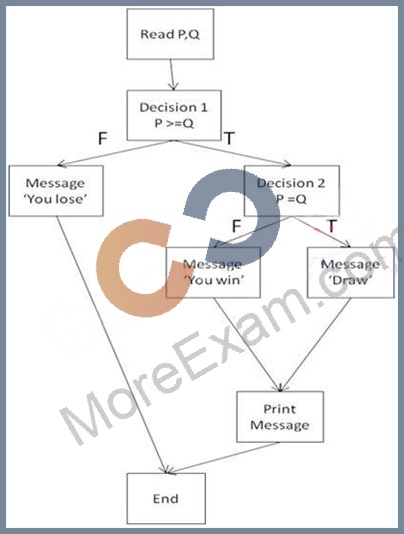
Question130: Which of the test cases below will exercise both outcomes from decision 2?
Refer to the exhibit

Question131: Which is the best definition of complete testing..?

Question132: Which of the following statements BEST describes one of the seven key principles of software testing?

Question133: Which of the following is not true of regression testing?

Question134: According to the ISTQB Glossary, regression testing is required for what purpose?

Question135: When an organization considers the use of testing tools, they should:

Question136: Designing the test environment set-up and identifying any required infrastructure and tools are a part of which phase:

Question137: Which of the following are static techniques?

Question138: A deviation from the specified or expected behavior that is visible to end-users is called:

Question139: Test script TransVal 3.1 tests transaction validation via screen TRN 003B. According to the specification (PID ver 1.3 10b iv) the validation screen should not accept future dated transactions. Test script TransVal
3.1 passes. Test script eod 1.4 tests end of day processing and is run after the execution of TransVal 3.1 using data entered during that test Which of the following is the BEST detail on an incident report?

Question140: Which of the following statements are TRUE?
A: Regression testing and acceptance testing are the same.
B: Regression tests show if all defects have been resolved.
C: Regression tests are typically well-suited for test automation.
D: Regression tests are performed to find out if code changes have introduced or uncovered defects.
E: Regression tests should be performed in integration testing.

Question141: Which of the following is not a major task of Exit criteria?

Question142: Which is not the testing objective?

Question143: What is the purpose of a test completion criterion?

Question144: Consider the following statements about early test design:
i. Early test design can prevent fault multiplication
ii. Faults found during early test design are more expensive to fix
iii. Early test design can find faults
iv. Early test design can cause changes to the requirements
v. Early test design takes more effort

Question145: Which of the following statements about use-case testing are most accurate?
(i)In a use-case diagram an actor represents a type of user.
(ii)Use-cases are the most common test basis for unit testing.
(iii)A use-case describes interactions between actors.
(iv)An actor is always a human user that interacts with the system.
(v)Test cases can be based on use-case scenarios.
(vi)Use-case testing will often identify gaps not found by testing individual components.

Question146: Component testing may include:

Question147: Which of the following is usually the test basis for integration testing?

Question148: Statement Coverage will not check for the following:

Question149: Which activities form part of test planning?
i) Developing test cases.
ii) Defining the overall approach to testing.
iii) Assigning resources.
iv) Building the test environment.
v) Writing test conditions.

Question150: What content would be in an incident report if that incident report was based on the IEEE 829 Standard for SoftwareTest Documentation?
(i)Identification of configuration items of the software or system.
(ii)Software or system lifecycle process in which the incident was observed.
(iii)Description of the anomaly to enable reproduction of the incident.
(iv)Number of occurrences of the incident.
(v)Classification of the cause of the incident for metrics and for reporting purposes.

Question151: When a defect is detected and fixed then the software should be retested to confirm that the original defect has been successfully removed. This is called:

Question152: What is a test condition?

Question153: Test objectives for systems testing of a safety critical system include completion of all outstanding defect correction. Regression testing is required following defect correction at all test levels. Which TWO of the following metrics would be MOST suitable for determining whether the test objective has been met?
a. Regression tests run and passed in systems testing
b. Incidents closed in systems testing
c. Planned tests run and passed in system testing
d. Planned tests run and passed at all levels of testing
e. Incidents raised and closed at all levels of testing

Question154: Of the following, select the best description of the fundamental test process:

Question155: Security falls under..?

Question156: What are the key features to be concentrated upon when doing a testing for world wide web sites ..?

Question157: Which of the following is a valid reason for writing test cases based on experience and intuition?

Question158: Which TWO of the review types below are the BEST fitted (most adequate) options to choose for reviewing safety critical components in a software project? Select 2 options.

Question159: Which is not the fundamental test process?

Question160: One of the roles in a review is that of moderator, which of the following best describes this role?

Question161: Which of the following statements about risks is most accurate?

Question162: Which of the following is most likely to be performed by developers?

Question163: Which of the following is the main purpose of the component build and integration strategy?

Question164: The following statements relate to activities that are part of the fundamental test process.
i. Evaluating the testability of requirements.
ii. Repeating testing activities after changes.
iii. Designing the test environment set-up.
iv. Developing and prioritizing test cases.
v. Verifying the environment is set up correctly.
Which statement below is TRUE?

Question165: Which of the following is true about the V-model?

Question166: Which of the following processes ensures that all items of testware are identified, version controlled, tracked for changes, so that traceability can be maintained throughout the test process?

Question167: Tests are prioritized so that:

Question168: Which of the following are the typical defects found by static analysis tools?
a. Variables that are never used.
b. Security vulnerabilities.
c. Poor performance.
d. Unreachable code.
e. Business processes not followed.

Question169: Which of the following are aids to good communication, and which hinder it?
i. Try to understand how the other person feels.
ii. Communicate personal feelings, concentrating upon individuals.
iii. Confirm the other person has understood what you have said and vice versa.
iv. Emphasize the common goal of better quality.
v. Each discussion is a battle to be won.

Question170: What factors should be considered to determine whether enough testing has been performed?
(i)The exit criteria.
(ii)The budget.
(iii)How big the test team is.
(iv)The product's risk profile.
(v)How good the testing tools are.
(vi)Sufficient details of the system status to allow decisions

Question171: Which of the following has the typical formal review activities in the correct sequence?

Question172: Reviewing the test Basis is a part of which phase

Question173: Which of the following best describes the Black-box technique?
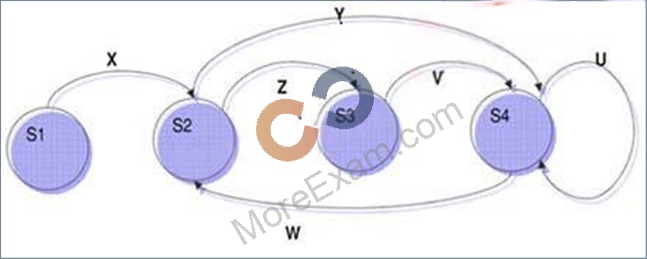
Question174: Refer to the exhibit

Given the following State Transition diagram, match the test cases below with the relevant set of state transitions.
(i) X-Z-V-W
(ii) W-Y-U-U

Question175: Which type of review has the following main purposes:
discussing, making decisions, evaluating alternatives, finding defects, solving technical problems and checking conformance to specifications, plans, regulations, and standards?

Question176: Which of the following characteristics of good testing apply to any software development life cycle model?

Question177: Which of the following are most characteristic of structure-based testing?
(i) Information about how the software is constructed is used to derive test cases.
(ii) Statement coverage and/or decision coverage can be measured for existing test cases.
(iii) The knowledge and experience of people are used to derive test cases.
(iv) Test cases are derived from a model or specification of the system.

Question178: What is the main reason for using a pilot project to introduce a testing tool into an organization?

Question179: Hand over of Testware is a part of which Phase:

Question180: Which of the following is true of iterative development?

Question181: Which of the following test design techniques is classified as a structure-based (white box) technique?

Question182: A top-down development strategy affects which level of testing most?

Question183: Which of the following is a structure-based (white-box) technique?
Question184: Consider the following pseudo code:
1 Begin
2 Read Time
3 If Time < 12 Then
4 Print(Time, "am")
5 Endif
6 If Time > 12 Then
7 Print(Time −12, "pm")
8 Endif
9 If Time = 12 Then
10 Print (Time, "noon")
11 Endif
12 End
How many test cases are needed to achieve 100 per cent decision coverage?

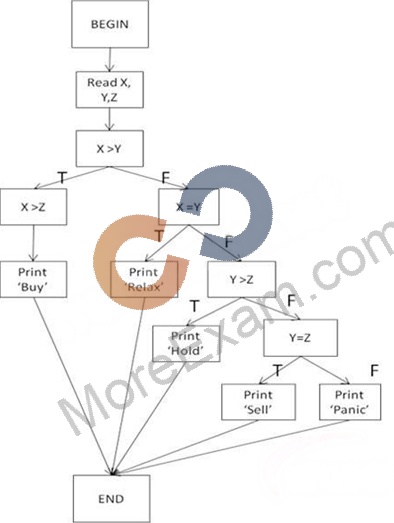
Question185: Which of the following test cases will ensure that the statement 'Print 'Hold'' is exercised?
Refer to the exhibit

Question186: Which of the following statements are true?
(i) For every development activity there is a corresponding testing activity.
(ii) Each test level has the same test objectives.
(iii) The analysis and design of tests for a given test level should begin after the corresponding development activity.
(iv)Testers should be involved in reviewing documents as soon as drafts are available in the development life cycle.